Digital information drives participation in politics, the economy, and society. Yet great disparities exist as to which communities have access to the internet. In 2017, only half of residents of formerly industrial Flint, Michigan, had broadband or satellite internet at home, while over 90 percent of those in thriving Sunnyvale, California, in Silicon Valley, were connected. More recently, Covid-19 laid bare these persistent digital divides in both urban and rural communities, illustrating that broadband use is a fundamental resource for the future of opportunity in communities.
While previous studies have examined the impacts of broadband infrastructure, they have indicated little about the extent to which local populations can afford and use the technology. Moreover, there has been limited scientific evidence on how broadband adoption matters for collective benefits. Including new data on broadband subscriptions from 2000-2017, and comprehensive analysis for U.S. states, counties, metros, cities, and neighborhoods, Choosing the Future argues that broadband use in the population is a form of digital human capital that benefits communities as well as individuals.
Broadband has a causal impact across all types of communities–for economic prosperity, growth, income, employment, and policy innovation. Yet there are urban neighborhoods and rural counties where as little as one-quarter of the population has a broadband subscription, even when mobile is included. As we build “smart” cities and communities, as economies and jobs continue to experience rapid change, and as more information and services migrate online, it is communities with widespread broadband use that will be best positioned for inclusive innovation, with the digital human capital to thrive.
Michele Norris
The 2022 Goldsmith Career Award winner was Michele Norris, whose career in print, television, and radio has made her a leading voice on race, identity, and the nature of modern American democracy.
“The music of Michele’s writing is matched by its moral power,” said Shorenstein Center Director Nancy Gibbs. “She picks up the hard questions and examines them fearlessly, in a way that has made her one of the great, wise voices of this generation.”.
2022 Goldsmith Career Award winner Michele Norris:
Michele Norris is a columnist for The Washington Post opinion page and her voice will be familiar to followers of public radio, where from 2002 to 2012 she was a host of National Public Radio’s afternoon magazine show, All Things Considered. Norris is also the Founding Director of The Race Card Project, a Peabody Award-Winning narrative archive where people around the world share their experiences, questions, hopes, dreams, laments, and observations about identity –in just six words–as the starting point for conversations about race. Norris is also a National Geographic Storytelling Fellow.
She is the author of The Grace of Silence, A Memoir where Norris turns her formidable interviewing and investigative skills on her own background to unearth long-hidden family secrets that raise questions about her cultural legacy and shed new light on America’s complicated racial history. Norris is currently at work on her second book exploring race and identity in America in the period bookended by the presidencies of Barack Obama and Donald Trump. She has received numerous awards for her work, including Emmy, Peabody, and Dupont Awards. In 2009, she was named “Journalist of the Year” by the National Association of Black Journalists. Before joining NPR in 2002, Michele spent almost ten years as a reporter for ABC News in the Washington Bureau. She has also worked as a staff writer for the Washington Post, Chicago Tribune, and the Los Angeles Times.
Norris was a 2015 Joan Shorenstein Fellow at the Shorenstein Center on Media, Politics and Public Policy. She is a judge for The Chancellor Awards and a board member for the Peabody Awards. She is also a board member of the President Obama oral history project at Columbia University and the storytelling committee for the Obama Presidential Center under construction in the South Side of Chicago.
Watch Michele Norris’ 2022 Goldsmith Career Award acceptance speech:
FEMA’s Disasters
Washington Post reporters spent 2021 traversing the corners of the country most ravaged by natural disasters to find out if the government really has people’s backs in the long-term. The reporters conducted 300 interviews and several databases, filed dozens of records requests, and analyzed thousands of pages of individual Federal Emergency Management Agency (FEMA) case records and other documents. What they found was that FEMA was regularly not providing help when it was needed for survivors of disasters. They chronicled the agency denying help to Black families living on land passed down since a generation after slavery, abandoning poor families without assistance for transitioning out of FEMA trailer parks as they shut down, and denying aid to 90% of disaster survivors, often for minor errors in their paperwork. This reporting led to major process changes at FEMA to directly address these issues, and bipartisan legislation currently working its way through Congress.
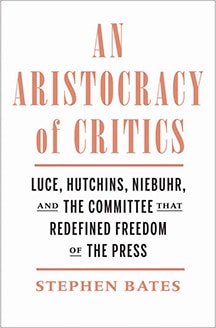
An Aristocracy of Critics: Luce, Hutchins, Niebuhr, and the Committee That Redefined Freedom of the Press
In 1943, Time Inc. editor-in-chief Henry R. Luce sponsored the greatest collaboration of intellectuals in the twentieth century. He and University of Chicago president Robert Maynard Hutchins summoned the theologian Reinhold Niebuhr, the Pulitzer-winning poet Archibald MacLeish, and ten other preeminent thinkers to join the Commission on Freedom of the Press. They spent three years wrestling with subjects that are as pertinent as ever: partisan media and distorted news, activists who silence rather than rebut their opponents, conspiracy theories spread by shadowy groups, and the survivability of American democracy in a post-truth age. The report that emerged, A Free and Responsible Press, is a classic, but many of the commission’s sharpest insights never made it into print. Journalist and First Amendment scholar Stephen Bates reveals how these towering intellects debated some of the most vital questions of their time—and reached conclusions urgently relevant today.
Stephen Bates is an associate professor in the Hank Greenspun School of Journalism and Media Studies at UNLV. His research focuses on the First Amendment. He is the author of An Aristocracy of Critics: Luce, Hutchins, Niebuhr, and the Committee That Redefined Freedom of the Press (Yale University Press), as well as books on the history of journalism, political advertising, and religious freedom. His articles have appeared in Journalism and Mass Communication Quarterly, Communication Law and Policy, American Journalism, Journalism History, and the International Journal of Communication, as well as the Washington Post Magazine, American Heritage, the Wall Street Journal, and the Wilson Quarterly, where he spent nine years as literary editor. A former board member of the ACLU of Nevada, Bates is a member of the advisory board of the Black Mountain Institute at UNLV. He has been a fellow of the Woodrow Wilson International Center for Scholars, the Annenberg Washington Program in Communications Policy Studies, and the Shorenstein Center on Media, Politics, and Public Policy. He holds an A.B. and a J.D. from Harvard University.
Manipulating the Masses: Woodrow Wilson and the Birth of American Propaganda
Manipulating the Masses tells the story of an enduring threat to American democracy that arose out of World War I: the establishment of pervasive, systematic propaganda as an instrument of the state. During the Great War, the federal government exercised unprecedented power to shape the views and attitudes of American citizens. Its agent for this was the Committee on Public Information (CPI), established by President Woodrow Wilson one week after the United States entered the war in April 1917.
Driven by its fiery chief, George Creel, the CPI established a national newspaper, cranked out press releases, and interfaced with the press at all hours of the day. It spread the Wilson administration’s messages through articles, cartoons, books, and advertisements in newspapers and magazines; through feature films and volunteer Four Minute Men who spoke during intermission; through posters plastered on buildings and along highways; and through pamphlets distributed by the millions. It enlisted the nation’s leading progressive journalists, advertising executives, and artists. It harnessed American universities and their professors to create propaganda and add legitimacy to its mission.
Even as Creel insisted that the CPI was a conduit for reliable, fact-based information, the office regularly sanitized news, distorted facts, and played on emotions. Creel extolled transparency but established front organizations. Overseas, the CPI secretly subsidized news organs and bribed journalists. At home, it challenged the loyalty of those who occasionally questioned its tactics. Working closely with federal intelligence agencies eager to sniff out subversives and stifle dissent, the CPI was an accomplice to the Wilson administration’s trampling of civil liberties.
John Maxwell Hamilton, a longtime journalist, author and public servant, is the Hopkins P. Breazeale Professor of Journalism at the LSU Manship School of Mass Communication; a global scholar at the Woodrow Wilson International Center for Scholars, Washington, D.C.; and a senior associate at the Center for Strategic & International Studies, Washington, D.C.
Hamilton’s most recent book (2020) is “Manipulating the Masses: Woodrow Wilson and the Birth of American Propaganda.” His previous book, “Journalism’s Roving Eye: A History of American Foreign Reporting,” won the Goldsmith Prize from the Shorenstein Center on Media, Politics & Public Policy, the Book of the Year Award from the American Journalism Historians Association and the Tankard Award from the Association of Education in Journalism and Mass Communication. He is editor of the LSU Press book series, “From Our Own Correspondent.”
Hamilton received the Freedom Forum’s Administrator of the Year Award in 2003. Other honors include two Green Eyeshade Excellence in Journalism Awards, the Byline Award from Marquette University and an MLK Day diversity award from LSU. He has received funding from the Carnegie and Ford foundations, among others. In 2002, he was a Shorenstein Fellow at Harvard University’s Kennedy School of Government. He has served twice as a Pulitzer Prize jurist. He is a member of the Metropolitan Club of Washington. Hamilton earned bachelor’s and master’s degrees in journalism from Marquette and Boston universities, respectively, and a doctorate in American Civilization from George Washington University.
Mississippi’s Dangerous and Dysfunctional Penal System
Mississippi has America’s most dangerous and antiquated penal system – The Marshall Project and Mississippi Today uncovered why. Severe understaffing has made prisons so dangerous that even guards aren’t safe. The state is paying millions of dollars to private prisons for workers who don’t show up. And Mississippi is the only state still running debtors prisons, where people with mostly low-level convictions are sentenced to prison-like facilities to work off fines, court fees, and restitution. Residents in these “restitution centers” often stay longer than necessary to pay off their debts. Lawmakers have called for defunding the centers and turning them into halfway houses, and the Mississippi State Auditor issued a scathing report, saying “the state must fix this, and now.” He also launched an investigation into the tax dollars paid for ghost workers.
Stephen Engelberg was the founding managing editor of ProPublica from 2008–2012, and became editor-in-chief on January 1, 2013. He came to ProPublica from The Oregonian in Portland, where he had been a managing editor since 2002. Before joining The Oregonian, Mr. Engelberg worked for The New York Times for 18 years, including stints in Washington, D.C., and Warsaw, Poland, as well as in New York. He is chairman of the Pulitzer Prize Board.
Mr. Engelberg’s work since 1996 has focused largely on the editing of investigative projects. He started the Times’s investigative unit in 2000. Projects he supervised at the Times on Mexican corruption (published in 1997) and the rise of Al Qaeda (published beginning in January 2001) were awarded the Pulitzer Prize. During his years at ProPublica, the organization won 6 Pulitzer Prizes. He is the co-author of “Germs: Biological Weapons and America’s Secret War” (2001).
Kathleen Carroll
Every year at the Goldsmith Awards Ceremony we celebrate a leading figure in journalism and media with the Goldsmith Career Award for Excellence in Journalism. This year’s honoree was Kathleen Carroll, longtime reporter and Executive Editor for the Associated Press, who successfully oversaw one of the world’s largest independent news agencies through a period of intense change in the industry.
Though the 2020 awards ceremony had to be canceled due to the COVID-19 pandemic, we are thrilled to honor Kathleen’s accomplishments and contributions to journalism, and to celebrate her extraordinary career with this tribute.
Thanks to the Associated Press and the Committee to Protect Journalists for providing images from Kathleen Carroll’s distinguished career for this video. Thanks also to her colleagues who spoke with us about their experiences working with Kathleen, particularly Kathy Gannon and John Daniszewski.
About Kathleen Carroll
Kathleen Carroll was Executive Editor and Senior Vice President of the Associated Press from 2002 through 2016, where she was responsible for coverage from journalists in more than 100 countries, including groundbreaking new bureaus in North Korea and Myanmar. Under her leadership, AP journalists won numerous awards, among them five Pulitzer Prizes – including the 2016 Pulitzer for Public Service – six George Polk Awards, and 15 Overseas Press Club Awards. She is currently Chair of the Board of Directors of the Committee to Protect Journalists, where she has served on the board since 2008. Carroll first joined the AP’s Dallas bureau in 1978, and was also a writer or editor for the AP in New Jersey, California and Washington. Previously, Carroll led the Knight Ridder Washington bureau, was an editor at the International Herald Tribune and at the San Jose Mercury News, and a reporter at the The Dallas Morning News in her hometown. She currently serves on the board of the weekly Montclair Local newspaper and served on the board of the Pulitzer Prizes from 2003-2012, the last year as co-chair.
Copy. Paste. Legislate.
The winner of the 2020 Goldsmith Prize for Investigative Reporting was “Copy. Paste. Legislate” by the staffs of The Arizona Republic, USA TODAY, and the Center for Public Integrity. The collaborative reporting team conducted unprecedented computer analysis of legislation in all 50 states to reveal 10,000 bills that were copied nearly word-for-word from text written by industry groups, lobbyists and political activists, often to benefit big business at consumers’ expense. Two tools built as part of the project are helping citizens and local reporters track these copycat bills in their own communities.
Martin “Marty” Baron began his career in journalism in 1976 as a state reporter for the Miami Herald, and has been the executive editor of the Washington Post since 2013. In between he held senior editing positions at the Boston Globe, the New York Times, the Los Angeles Times, and the Miami Herald. Under his leadership the Boston Globe won the 2003 Goldsmith Prize for Investigative Reporting and the 2003 Pulitzer Prize for Public Service for the investigation into clergy sex abuse in the Catholic Church that was later portrayed in the Oscar-winning film “Spotlight”. Baron and newsrooms under his leadership have been finalists or winners for many journalism awards over the years, including numerous Goldsmith and Pulitzer Prizes, in honor of their significant contributions to journalism, civic discourse, and public policy debates in the United States and around the world.